

Travel planning update — 15 October 2026: UK travel advice recommends against travel to Tigray and reports civilian flights to and from the region suspended since 22 September 2026. This itinerary can be discussed for future travel; airport connections and route access must be re-established before a booking is confirmed. Check current official travel advice and your insurance conditions.
Start with the landscape and your limits
Gheralta is a destination where the route to a church can be as consequential as what you find inside. Before selecting names from a photograph collection, decide how you feel about steep walking, exposed ground and heights. A famous church is not an obligation. Your most rewarding visit may be a carefully chosen walk, a lower-level cultural stop or time looking across the mountain landscape with a knowledgeable guide. A plan that respects your limits leaves more attention available for architecture, religious art and the setting of the places you visit.
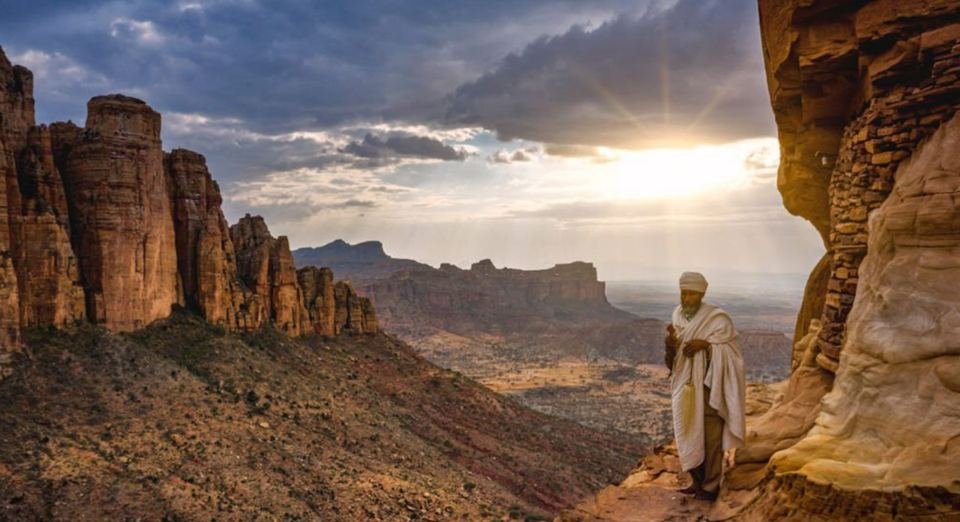
Gheralta lies in Tigray in northern Ethiopia and is associated with rock-hewn churches set among sandstone mountains. Visit Ethiopia identifies Abune Yemata Guh, Maryam Korkor and Daniel Korkor among notable examples, describing the especially dramatic cliff access to Abune Yemata. This brief orientation is supported by its Gheralta destination entry. The listing establishes the character of the destination, not present permission to visit or the suitability of any approach for a particular traveler.
Current access takes priority
Plan your route against current government travel advice and discuss transport, site access and accommodation with MUKA for your exact dates. Conditions can change; a historic itinerary or photograph does not establish present access.
Choose a church by its approach
Ask for a plain description of every proposed approach: the walking time, steepness, surface, exposed sections, handholds and turnaround options. Request recent, accurately identified photographs where these help explain the terrain. Do not accept “moderate hike” as sufficient information for a route with exposure. Someone comfortable walking uphill may be uncomfortable crossing a ledge; someone experienced on rock may still dislike a long descent. These differences should shape the itinerary before the day begins. There should be no pressure to continue once you have identified a section beyond your comfort or ability.
Abune Yemata Guh: treat exposure seriously
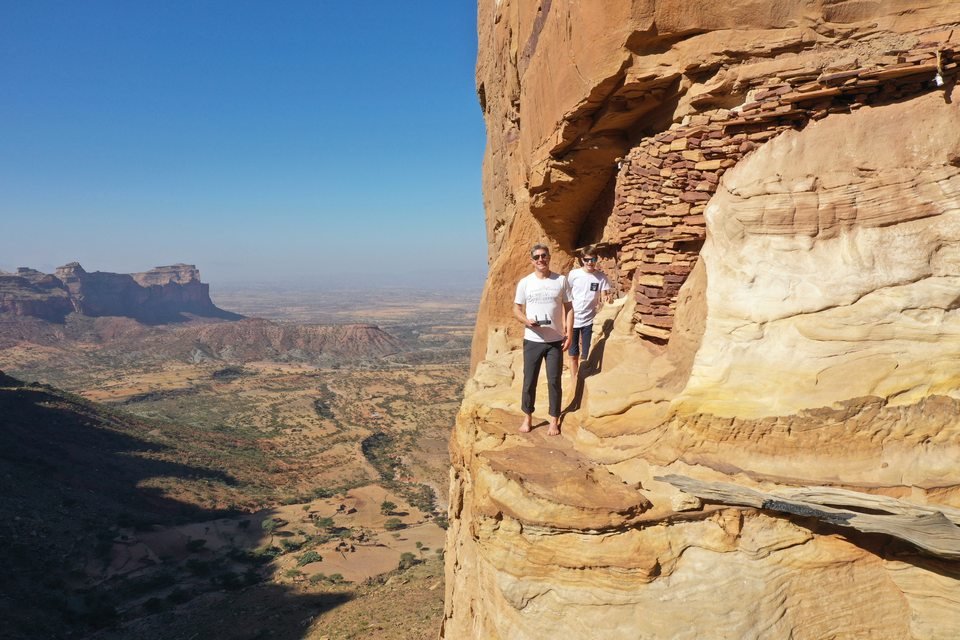
The attraction of a church high in a cliff does not make its approach an appropriate general sightseeing activity. Discuss whether visiting Abune Yemata Guh is suitable at all, who would assess the group and what conditions would stop the attempt. Do not assume that the availability of assistance or a rope makes an exposed route safe for everyone. Ask about the qualifications and actual arrangement of any proposed support, and seek a less exposed alternative if the explanation does not match your needs. A visitor’s ability to decline must remain clear throughout.
A distant view and an informed conversation about the church can still be valuable. Avoid framing those who stay below as people who missed the “real” experience. Mixed groups may need a different plan for the entire party rather than leaving some travelers waiting without shade, water or an agreed pickup. If photography is a priority, ask about permitted viewpoints that do not require an unsuitable ascent. No photograph should be used to persuade someone into a route they have already declined.
Maryam Korkor and architectural attention
Lonely Planet’s editorial description highlights Maryam Korkor’s architectural features and paintings, and notes a steep approach. Use that as a reason to ask detailed access questions, not as a current walking-time guarantee. Its Maryam Korkor entry is supplementary background. If a visit is appropriate and permitted, ask the guide to focus on a few details such as the organization of the interior or the relationship between structural forms and painted surfaces. Allow the place to become more than the reward at the end of a climb.
Daniel Korkor is another name to discuss with a local specialist, but nearby does not necessarily mean effortless to combine. Ask what the linking section involves and whether everyone can comfortably return by the required route. An itinerary should identify which additions are optional and at what point the decision is made. Do not rely on the apparent proximity of two places on a map, because map distance does not describe exposure, route finding or access permission.
Experiences beyond collecting church names
A satisfying Gheralta day can include learning how a religious site relates to the surrounding landscape, observing the changing light on the sandstone and having an unhurried conversation with a guide. If a community encounter is proposed, ask who has agreed to host it and what form it will take. Do not assume that people living near a visitor route are available for a scheduled performance. Seek opportunities for reciprocal conversation, with permission and fair arrangements, rather than a sequence of portraits gathered on the way to another attraction.
How long to stay
For a future local visit, consider two or three nights as a starting discussion, depending on the amount of walking and transfer time involved. One principal outing per day may be a better framework than multiple challenging approaches. It provides room to assess how the first day feels and adjust the second. Travelers combining Gheralta with Aksum need to account separately for the connecting transfer; it should not consume a day still described as a full church visit. The Aksum–Gheralta itinerary uses four days as an initial framework, with arrangements confirmed for your dates.
Transport and arrival points
Clarify whether your plan begins in Aksum, Mekelle, Hawzen or at a named accommodation. These are distinct starting arrangements, and none should be implied by the phrase “Gheralta tour.” Ask who is responsible for reaching the meeting point and whether any flight is included. Current services, road conditions and the feasibility of crossing between places must be confirmed directly. If travel cannot proceed by the intended route, do not assume another route is an acceptable substitute without the same review. The appropriate alternative may be a revised trip or postponement.
A vehicle transfer to a trailhead does not determine the walking conditions that follow. Ask where the driver waits, how the guide communicates with the vehicle and what happens if you turn back early. Keep any change of meeting point explicit. In a group with different walking preferences, separate vehicles or guides may be necessary; that needs planning and a clear quotation. Do not build a plan around improvising support at the foot of a climb.
Hawzen, Megab and accommodation choices
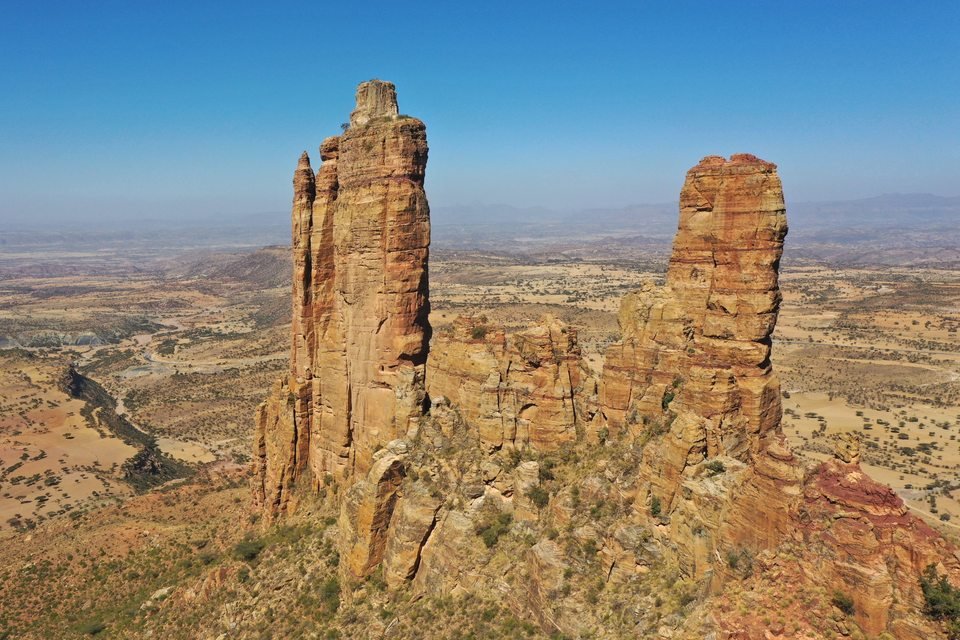
Hawzen and Megab are useful location names when discussing a base in the Gheralta area. Ask MUKA to compare the actual drive to your proposed church approaches, meal arrangements and room accessibility. A property chosen for its landscape setting may have practical tradeoffs in transfers, paths or facilities. Confirm the name and current operation of any accommodation before it becomes part of a final itinerary. No particular lodge is promised in this guide. For travelers who need an early return after walking, the location of the base matters more than a decorative room photograph.
Weather and the timing of a walking day
Plan around the condition of the rock and the group’s comfort, not simply a month described as favorable. Ask how recent rain, wind or strong sun would affect the approach. A route with exposure may need to be cancelled even when travel elsewhere is possible. Carry suitable weather protection and the water specified for the actual outing, and keep your hands free where the guide says this is necessary. Do not carry loose photographic equipment that distracts you from foot placement. Weather decisions should be made before the group feels committed to finishing a climb.
Physical demands and alternative plans
Be specific about your experience. Mention whether you have walked on exposed ground, how you handle steep descents and whether you can comfortably use your hands while climbing. Also explain any balance, knee or vision concerns that may affect the route. A general fitness level is not a substitute for this information. Ask for an alternative plan that has real content: a suitable viewpoint, a different permitted church or a landscape-focused visit. “Wait for the others” is not a complete alternative unless a comfortable and agreed waiting arrangement genuinely suits you.
Religious etiquette and photography
Ask about dress, shoe removal and access restrictions before reaching the church entrance, so that changing clothes or reorganizing equipment does not obstruct others. Follow the custodians’ instructions on photographs, flash and video. Do not touch painted surfaces or use them to steady yourself. Portraits of clergy and worshippers require permission, and an admission payment does not override that choice. If religious activity changes the plan, allow space for it. The church’s continuing role in the community gives it meaning beyond its architectural interest.
Food, rest and practical details
On a walking day, discuss the meal arrangement and the point at which you will have a proper break. If a packed meal is proposed, explain dietary restrictions in advance and carry out all packaging. Keep essential personal items with you rather than assuming the vehicle will be immediately accessible. Ask what communications and assistance arrangements are available along the actual route, without assuming that mobile coverage or emergency evacuation can be guaranteed. A clear plan helps everyone make a sensible decision about the activity before departure.
Frequently asked questions
Do I have to climb Abune Yemata to appreciate Gheralta?
No. Build the trip around your interests and a suitable level of exposure. The landscape and religious heritage can be explored through a carefully chosen combination of permitted viewpoints, churches and guided interpretation without making one famous ascent compulsory.
Can several churches be visited in one day?
Potential combinations need to be assessed individually. Count the transfers, approaches, time inside, rest and return rather than relying on the number of names. One well-chosen church can provide a fuller experience than several rushed or unsuitable climbs.
Is Gheralta suitable for children?
A child’s age alone cannot establish suitability. The exact exposure, walking demands and supervision arrangements matter. A family plan should use routes specifically assessed for the youngest or least confident participant and should not assume an adult itinerary can simply be repeated at a slower speed.
Can the route change on the day?
It should be possible to stop an unsuitable activity, but a meaningful substitute requires advance planning. Ask which alternatives have been checked and how a change affects transport, staffing and cost. Avoid a promise that every requested adjustment is automatically possible.
Related MUKA journeys
The existing Grand Ethiopia Tour supplies a broader catalogue context. A proposed four-day Aksum–Gheralta local-start itinerary is available to discuss as a shorter itinerary. It remains conditional on MUKA’s access, route and service review, and should not be interpreted as an available departure or a commitment to visit any exposed church.
Research sources
Reviewed by MUKA Ethiopia Tours · 15 October 2026.

